
Cutting Scheme in Half

The Scheme steering committee has decided to sever the Scheme language into “Large Scheme” and “Small Scheme.” Can we expect the same from Scheme-inspired languages like JavaScript? 🙂
The Scheme steering committee has decided to sever the Scheme language into “Large Scheme” and “Small Scheme.” Can we expect the same from Scheme-inspired languages like JavaScript? 🙂
Finally got the cranks on, the pedals on, the new 17 tooth cog on the old wheel that I re-tensioned and trued (well, partially trued at least), only to put the chain on with a broken chain tool. (I didn’t realize it was broken). So one of the bushings became bent, and on my ride home, I popped the chain. Tried to use alternate links to fix it, but they stuck (and ended up with only slightly bent bushings). So a new chain it is for me, unfortunately.
Not a technical post, but a personal update. I promised over a week ago. 
I’ve been exceptionally busy at work, we’re beginning to finish up a much needed, much discussed by librarians, redesign of PubMed. We’ve put a ton of user interaction effort into this project, as well as a good sprinkling of graphic design (watch out, I even did some parts!) I think people will be really positive about these new changes.
[Just for the record, if someone happens to stumble upon this from the librarian community, yes, release date is still end of summer, and yes, there will be a Beta period, so no need to worry about a short timeline to update your class or instructional slides. We do listen!]
It’s also been exciting that we’ve brought a few new people on board. Always exciting to have new hires, despite the fact that it’s a lot of work… and all of the trainings I have to do.
What else… I’m planning on attending the DelveUI masterclasses this week in Brooklyn. It will be interesting to see what some of the heads of state have to say about the field. I’m a little excited, this masterclass format isn’t the usual boring no-content fluff that you hear at most conferences. I get the feeling that there will actually be code present! My thanks to the lovely Jina “Sushi & Robots” Bolton for the opportunity for the free ticket.
I’ve been reading… way too many things. I’ve been reading Learning jQuery 1.3, jQuery UI 1.6, and jQuery in Action and you’ll see the reviews of those two books very soon. (Can you tell that we’ve switched to jQuery at NCBI?) I’m a little behind with that reading, but I’ve been working hard on other things. Additionally, I went on an Amazon spree, and started reading Programming the Semantic Web, An Introduction to Lambda Calculi for Computer Scientists, To Mock a Mockingbird, 101 Things I learned in Architecture School, Code Complete 2. Last but not least, I’ve also been reading any photography book that I can get my hands on.
Yes, that is a lot of books, and I haven’t had much time for them. I’ve been working hard at work, and I want to relax a bit when I come home. Once summer ends, things will return to a slightly more regular pace. I’ve been learning so much on the job, that I’m not very worried about falling behind in reading.
Continue readingOn Mar 31, 2009, at 11:45 AM, Edward Welker wrote:
Aaron wrote:
This may be one of the best URLs I have ever seen:
http://www.ringling.com/FlashSubContent.aspx?id=11654&parentID=320&asset
FolderID=340Just looking at it, I can tell exactly what I can expect when I click
it.
***
To me, that URL tells a delightful children’s story…
FlashSubContent = a wonderful fantasy world
[elephant] id = 11654 [Dumbo]
[elephant] parentID = 320 [Mrs. Jumbo]
[cage] FolderID = 340 [because they took her Dumbo away, and Mrs. Jumbo got angry, so she had to get locked up]
aspx = evil clown makeup wearing Microsoft employees who locked Dumbo’s mother up
-e
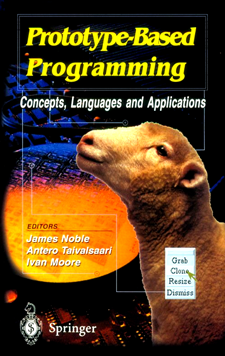
I ran across a mention of “Prototype-Based Programming” back when I was first learning JavaScript. I thought it would be an interesting read, but forgot to bookmark it, and forgot to look into it further. Once I finally remembered it, it proved hard to find (and an expensive gamble from Amazon), until I found it through NIH’s interlibrary loan system.
I was quite excited to get my hands on a copy of this book, I was interested in learning more about the general theory that went into languages with prototypal inheritance. I thought this would allow me a special insight into JavaScript. However, as I found reading it… despite it’s 1999 publication date, JavaScript wasn’t even mentioned in the book! Regardless, I found parts of it to be quite interesting and insightful.
The book is broken up into three sections (as mentioned on the cover), Concepts, Languages, and Applications. Each section has 4 associated chapters which are really various papers, some of which seem to be difficult to find elsewhere.
The first section, “Concepts” was the most interesting. The first was titled “Classes vs. Prototypes: Some Philosophical and Historical Observations.” This chapter provided a nice introduction to the topic, including the history of classification, going back to Aristotle and proceeding to Ludwig Wittgenstein who had an interesting example about classifying the characteristics of an item as simple as a “game”. It goes on to transition to a programming perspective. A point that is made repeatedly throughout many chapters that the idea of classical inheritance necessitating construction from the top (superclasses) to the bottom (subclasses) is inherently contradictory to the way humans think. When unfamiliar with a domain, a person can more easily deal with concrete examples, and only discern the abstract general form after discovering these patterns in the concrete cases. Though unable to put my finger on this idea, I’ve experienced it a number of times when programming myself, and couldn’t agree more.
The next chapter, “Classifying Prototype-based Programming Languages” sought to categorize the theoritical aspects of different prototypal languages. This is the chapter where I most missed the reference to JavaScript, but I may look into doing that myself some other day. “The Stripetalk Papers: Understandability as a Language Design Issue in Object-Oriented Programming Systems”, made an argument that prototype based systems could be used to enhance the learnability of languages. Finally, the chapter “Classes versus Prototypes in Object-Oriented Languages” looked at the advantages and disadvantages of class-based and prototype-based languages. This chapter was quite interesting, however brief.
Continue reading